
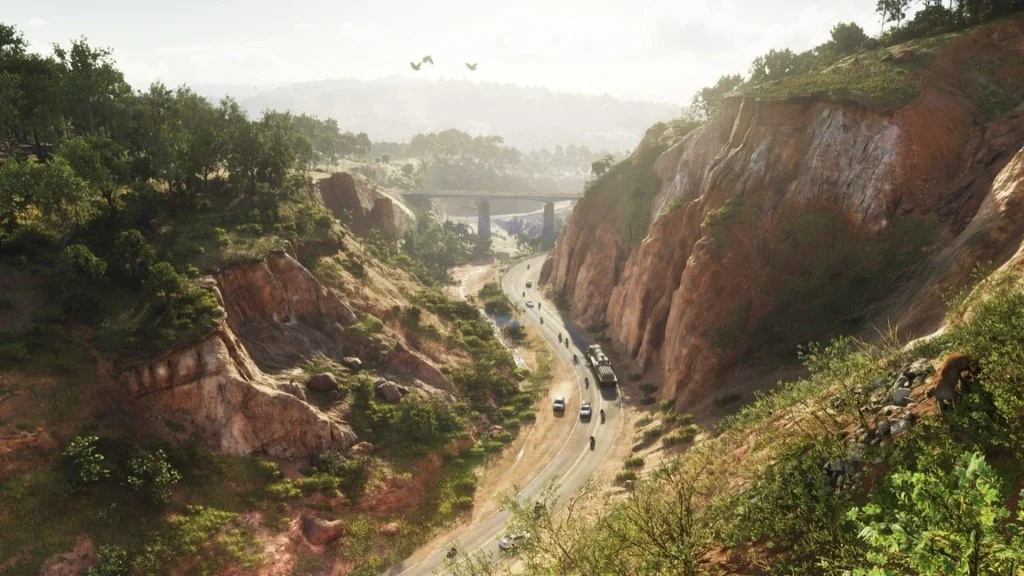
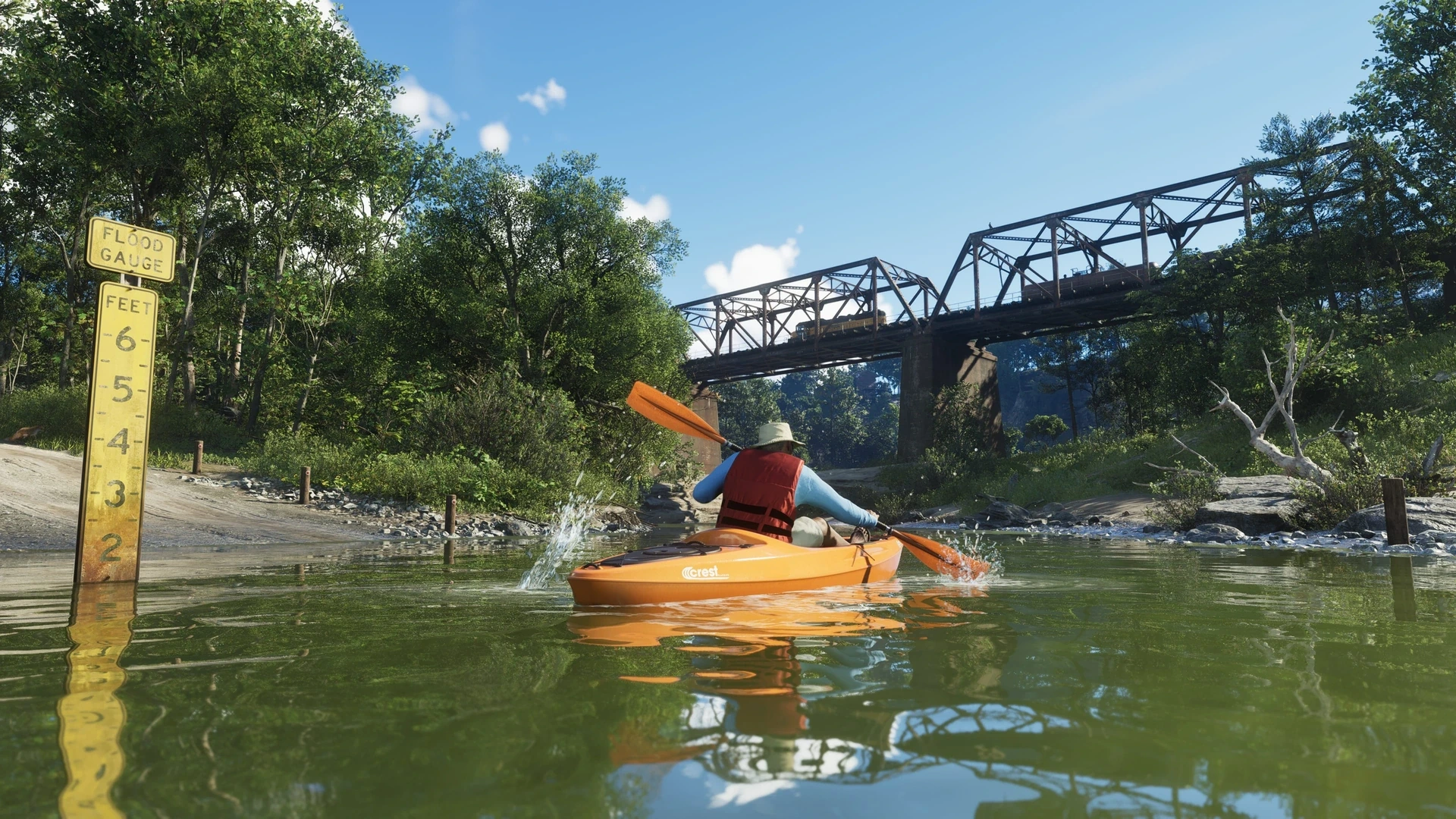
Rockstar's official GTA VI gallery places Mount Kalaga National Park in the northern part of Leonida, and its published description points to hunting, fishing and off-road trails. The screenshots show water, steep terrain, forest and quiet, remote areas far from the crowded streets of Vice City. Because of this, the same open world may feel different: distances stretch out, vehicle choice matters more, and danger comes from unfamiliar ground rather than city traffic.
Steep ground and long roads make route choice important
One rule separates a useful mountain region from a decorative one: elevation has to change how players move. Roads should wind around slopes, shortcuts should call for a suitable vehicle, and a reckless descent should carry a genuine penalty. Cities usually give drivers several parallel streets to choose from. In Mount Kalaga, a single blocked bridge or one damaged vehicle can leave the alternative route far longer.
Open-world design increasingly relies on the environment to create tension instead of on-screen numbers. In GTA 6, fuel, vehicle condition and weather don't each need a complicated meter to make players plan ahead. Spacing services farther apart does the job, and a fast sports car simply won't cope with a muddy trail. Players pick up the rule from the terrain itself, without a warning box telling them what to do.
Hunting and fishing reward observation instead of speed
Rockstar tied the park directly to hunting and fishing. After the dense stretches of Vice City, these activities offer a slower rhythm, but they still ask the player to watch closely. Animal movement, the state of the water and ambient sound all point toward a good spot. Placing a marker on every target would turn the wilderness into just another city checklist.
A loose collection of side activities can do more than fill time between missions. Fishing, for instance, may matter to a local shop that depends on what people bring in, and a hunting trip might lead to a resident who knows a back road missing from the main map. Such rewards need not be the strongest gun or the biggest cash payout. For a national park, knowledge and access suit the setting far better than yet another row of pricey storefronts.
Trucks and all-terrain vehicles are built for rough ground. Off-road trails give them a purpose.
Plenty of GTA titles fill their maps with pickup trucks and off-road machines, yet in city missions a plain, fast car often does the job just as well. Out in the rugged terrain around Mount Kalaga, that balance shifts. Ground clearance, traction and suspension suddenly matter, and a vehicle that feels sluggish on the highway can turn into the fastest option once the route runs over rock, through shallow water or into deep mud.
Level design for a vehicle-heavy game tends to live or die on feedback. When a truck spins out, the player should be able to tell why: was it entry speed, a slick patch of road, or a clip against a wall? If the cause is hidden behind an invisible boundary, the failure feels arbitrary and players stop trusting the course. Well-built trails usually give two options. The safe line is slower but reliable, while the hard line is quicker and rewards precise driving, without hinging on a single bounce that nobody can predict.
| Regional element | Likely design pressure |
|---|---|
| Steep terrain | Longer and more selective routes |
| Off-road trails | Vehicle choice matters |
| Hunting and fishing | Slower observation-based activity |
| Remote roads | Different pursuit and escape choices |
Police pursuits can work differently on remote roads
Wanted-level chases in a park play out differently than they do in the dense core of Vice City. Fewer patrol cars tend to show up, but helicopters and roadblocks take on a bigger role, since there are few roads to funnel traffic through. Stepping off the marked paths can shake pursuers from sight, though it also drags the player's speed down. That push and pull turns the landscape itself into a tool for getting away.
A group of smaller criminal jobs suits the region's remote stretches. Moving goods, reaching a hidden site, or cutting off a vehicle before it hits the main highway all fit a sense of isolation, and none of them depend on constant explosions. The tension comes from distance and uncertainty. When a missed junction could cost the player several minutes, that knowledge alone keeps each run taut.
Different activities give Mount Kalaga its own identity
Each region of the map, from Vice City and the Keys to the wetlands, industrial zones and Mount Kalaga, needs its own way of moving through it and its own reason to come back. Relying on colour alone would make them feel interchangeable. The park's character can instead come from elevation, long routes and outdoor activities. Heading north then feels like leaving one set of assumptions behind, not crossing a border that only changes the scenery.
Rockstar's official material is clear about where the game takes place and which attractions it includes. It is much less specific about the systems fans have imagined around them. Hunting, fishing and off-road trails are confirmed. Detailed wildlife AI, dynamic weather and vehicle inventories are not, and they stay open questions until Rockstar explains them. Drawing that line keeps the existing screenshots useful as evidence, without turning guesswork into a feature list.
The region needs activities that use its geography
Mount Kalaga stands apart only when it changes what the player decides. On a steep trail, the best vehicle may be a different one entirely. Poor reception can cut off quick information, and a narrow bridge can turn a basic getaway into something that needs real route planning. Dropping an urban activity into a countryside setting would squander the place. The game systems ought to make distance, elevation and terrain count, while keeping every journey from dragging into tedious travel.
A mission started in Vice City can later need a storage unit, a surveillance post, or a meeting in the national park. A discovery in Kalaga can then trigger fallout on the coast. These connections stop the wilderness from feeling like a side trip you make once and forget. Each region looks and feels distinct at street level, yet all of them feed the same larger story.